

 Ouni Editor
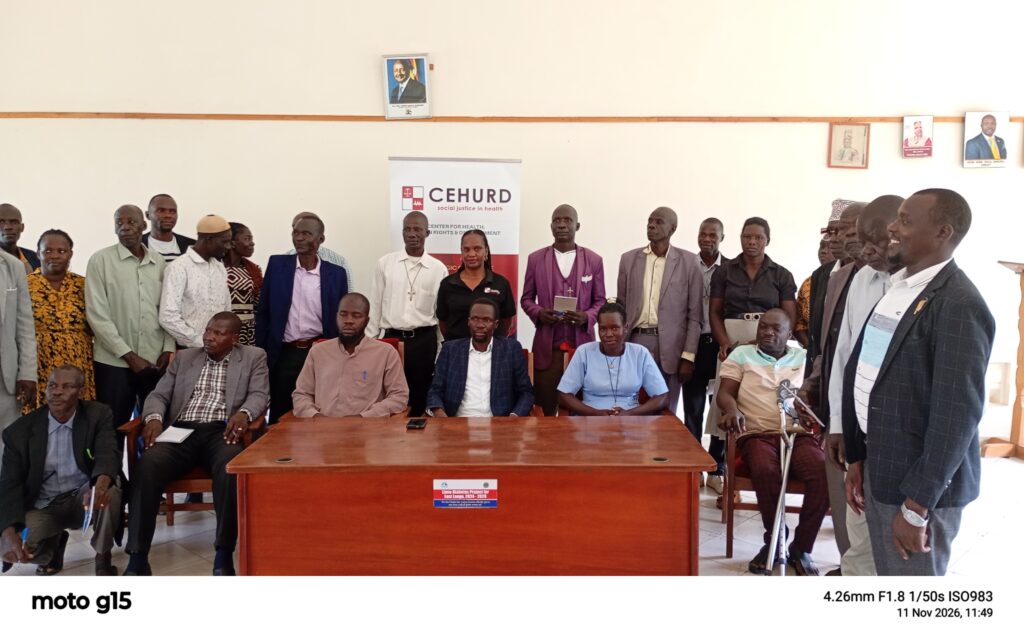
Center for Health, Human Rights and Development (CEHURD) with support from TASO and in collaboration with the Global Fund has sensitized leaders in Dokolo District to address human rights-related barriers to HIV, TB and malaria services.
The meeting that brought together the District Human Rights Committees (DHRCS) cultural, religious and opinion leaders in Dokolo district was able to answer and make stakeholders understand lots of human rights-related barriers.
Counsel Monicah Kurwenza also an offer at CEHURD and one of the facilitators told participants to be careful when dealing with human rights and should be able to differentiate between derogable and non derogable right.
The Deputy Speaker of Dokolo District Local Government, Lameck Ongora, has called on community leaders to take keen interest in addressing the challenges their communities are going through.
Ongora made the remarks while closing a meeting organised by the Center for Health, Human Rights and Development (CEHURD), with support from TASO and in collaboration with the Global Fund, to sensitize District Human Rights Committees (DHRCs), cultural, religious and opinion leaders in Dokolo District on addressing human rights-related barriers to HIV, TB and Malaria.
”It is a responsibility for both of us who have attended this to still go and emphasize the same message. The church leaders, the cultural leaders, let’s interest ourselves to look at what the communities are going through,” he explained.
According to him, if a cultural leader delays to handle a land conflict, what is the next step? Death. He said the more leaders delay to handle such issues, the more unnecessary situations they create in the community.
”I want to challenge all of us who have had an opportunity to attend this important session. It is not only about the small facilitation that we get from here or the good meals that we always get from here. What is your action point? What is your take-home from this gathering? That every small gathering that you always attend at home, you will be in a position to spread the message. Even in your sermon, at least you package where you tell our adolescent boys and girls about the HIV prevalence. When you’ve got this statistic and you talk to our young generations, at least one or two, three will pick the message,” Ongora said.
He said statistics on HIV prevalence still put girls aged 15 years and above as the age bracket with the highest rate of HIV prevalence, asking what this means to cultural leaders and the church.
”These ones we are getting, are they not praying? Are they not attending the different cultural gatherings? They do attend. What are the root causes?” he asked.
He said recently, in the month of October, six people in Lango Sub-region committed suicide. He questioned whether they go to church, noting that some of them were also born-again Christians.
Eugine Odongo, the Assistant District Health Officer and HIV/AIDS focal point person, Dokolo, thanked CEHURD for bringing together a very important and special category of leaders to discuss how to improve the rights and health of communities.
”Many of the issues that we are currently facing are more of social and economic problems. Community issues, especially for health, all the challenges we are finding are community-related factors. But at facility level and district level, we almost sorted everything except the community gaps, of course, one of which is uptake of health services as a result of lack of knowledge,” he said.
Odongo asked who is supposed to address this, saying cultural and religious leaders are trusted and their effect is huge.
He revealed that as a result of these gaps, Dokolo District is registering very high teenage pregnancies. In about a period of one month at Dokolo Health Centre IV, they operated on 14 teenage mothers aged 14 years.
He said they could not deliver normally and had to be operated on through Caesarean Section. He described these as effects of family breakdown and domestic violence at home.
”Please, let’s do our best to talk to communities, avoid stigma and discrimination, mobilize our people to uptake the different services, both at the different levels of sub-county and district level and also community,” he said.
Joel Opota, the Secretary for Health and Education, appreciated CEHURD for the many activities they are undertaking in the district.
”We are aware with modernity, especially the smartphones and other developments that we have within the community. The only issues of human rights are being abused, being violated, it needs some people to talk. That is why you have been carefully selected as a leader to come and listen to this interaction,” he said.
He urged LC1, LC2 and LC3 leaders to be active members who promote peace within the community.
